The native AI infrastructure that’s already operational
AI Agents that follow your rules, make your adjusters’ lives easier, and work with the data that’s already in your claims system.
Stop starting at square one
AI initiatives take years (or fail altogether) in P&C because every new tool sends your teams back to the starting line. Snapsheet AI integrates into your existing operations to put AI Agents at your fingertips across the full claim lifecycle on day one...
...and you never had to write a single line of code.
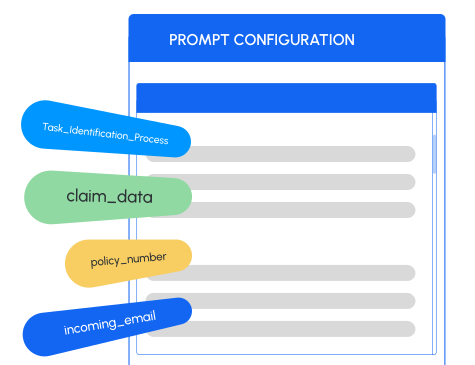
Aggregate
the data, context, rules, and guardrails already living in your claims operations.
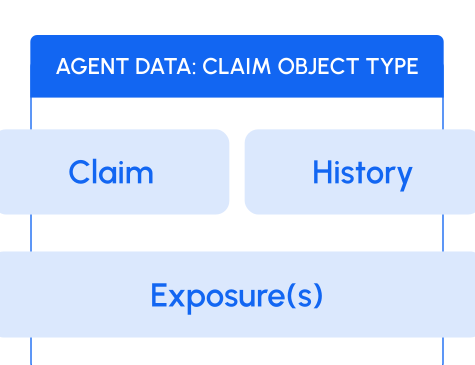
Snapsheet AI inherits the platform-level permissions, access controls and complete claims data already in place in the Snapsheet Claims environment.
.png)
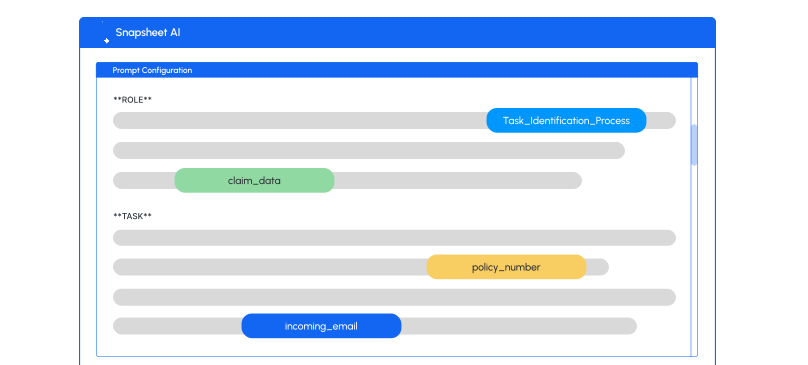
Architect
AI agents in plain language including the context to use, the actions to take, and the output you need. Claims and business teams can fully configure AI actions at the prompt-level including building agent-to-agent sequences and multi-step actions.
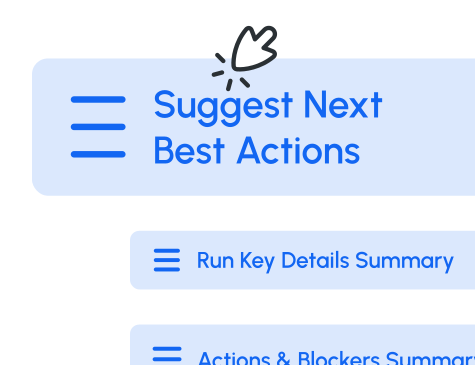
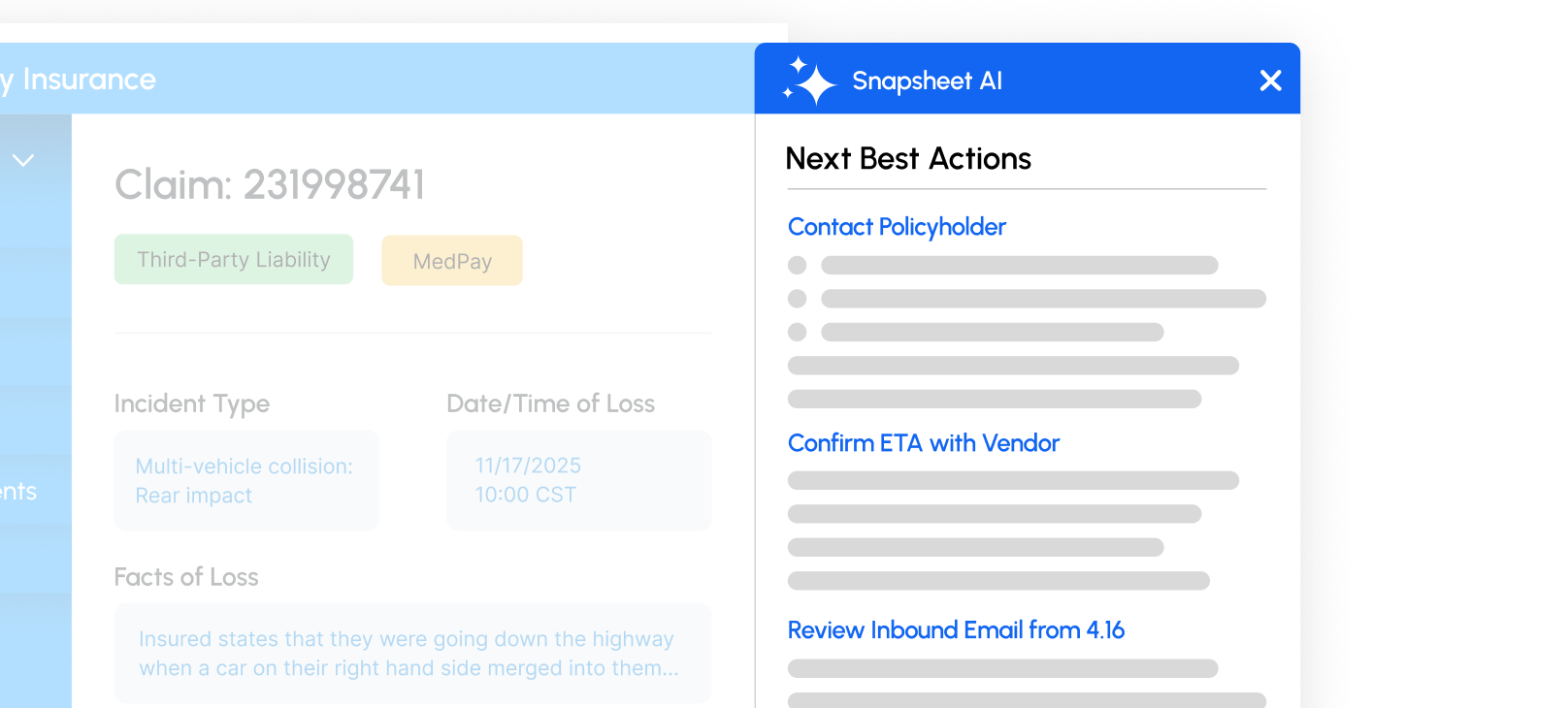
Assist
the decisions, judgement, and SOPs that deliver the right outcomes. Users can deploy agents on-demand via the claim co-pilot at the claim and exposure level to analyze documents, scan claim communications, assess claim health and customer sentiment, or tee up their next best actions.
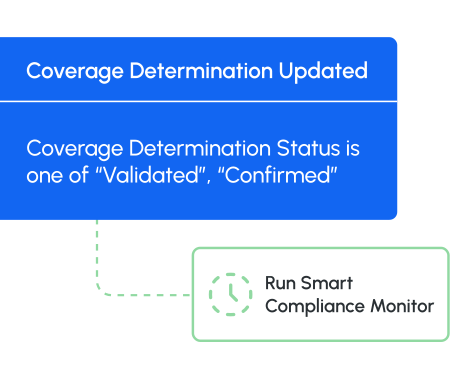
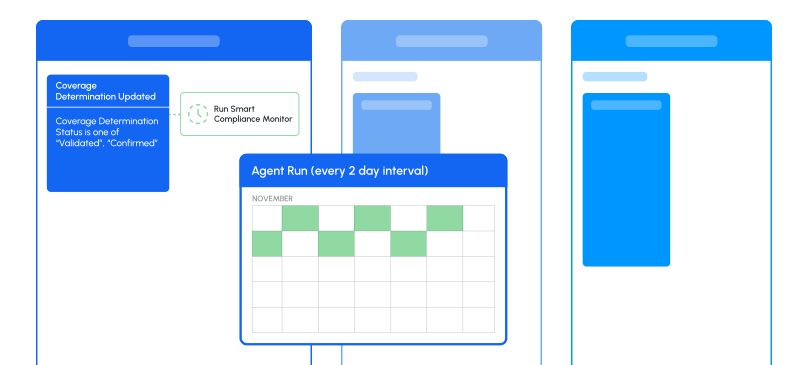
Automate
the tasks, patterns, and expertise that put those outcomes on repeat. AI Agents can be integrated directly into claims workflows with the no-code builder to trigger autonomous agent tasks based on claim events, activity, or conditions as configured.
Skip the patchwork and get to the real work
in adjuster time spent on claims
in average claim cycle time
on manager file reviews
on token usage to encourage adoption
Coverage across the full claim lifecycle means agents never lose the plot
Touchless Claim Routing
Every claim routes to the right desk based on the nuanced context that lives inside the file. New claims that meet user-defined criteria for touchless eligibility instantly enter STP workflows.
- Keep high-volume, straightforward claims out of your adjusters’ queues
- Let your adjusters be strategic decision makers instead of data entry producers
- Put humans back in the loop the second it’s needed to drive optimal outcomes
WatchDog
Eliminate the margin for error in compliance with a monitor that runs 24/7, and logs its findings directly in the claim file. In a hands-off loop, a scheduled task within your workflows triggers a real-time WatchDog report, evaluates any risk, and creates (and assigns) a review task when the file falls short.
- Proactively catch the missed deadlines that slip past busy adjusters
- Create review tasks only when the claim outcome is at risk (or outside of your guidelines)
- Apply the same compliance rules to every claim file to make 100% compliance rates the standard
Document Assistant Navigator
Turn dense documents like medical records, police reports, and complex estimates into a scannable brief in seconds. Extracted values are mapped to the right fields for fast accept, edit, or reject, and can be used to tag documents to trigger automatic next steps.
- Eliminate the burden of manual document scanning and data entry
- Turn document data into action triggers within workflows
- Catch deadlines, core details, or critical data hiding in document fine print that would usually get missed
Summarization Agents
Create instant recaps of full claim files to capture key details, create a brief of blockers and areas of risk on a claim, or generate a brief of the complete claim history on demand.
- Save hours of adjuster time per file
- Reduce supervisor review times by ~40% with scannable, timestamped recaps of the full claim history
- Trigger summarization agents automatically at key milestones in workflows and log outputs as notes directly in the claim file
Underwriting Co-Pilot
Claims data can be the most valuable information an underwriter can have at renewal time. The Underwriting Copilot replaces the hours adjusters would spend combing through emails, financials, and file activity to determine the health of a policy with an instant, intelligent audit that measures the claim against your own underwriting checks and criteria.
- Complete, end-to-end scans of emails, documents, financials, communications and file activity catch details manual reviews can miss
- Configurable evaluation criteria means your co-pilot can adapt alongside any internal policy changes or business evolutions
The right way to use AI is your way
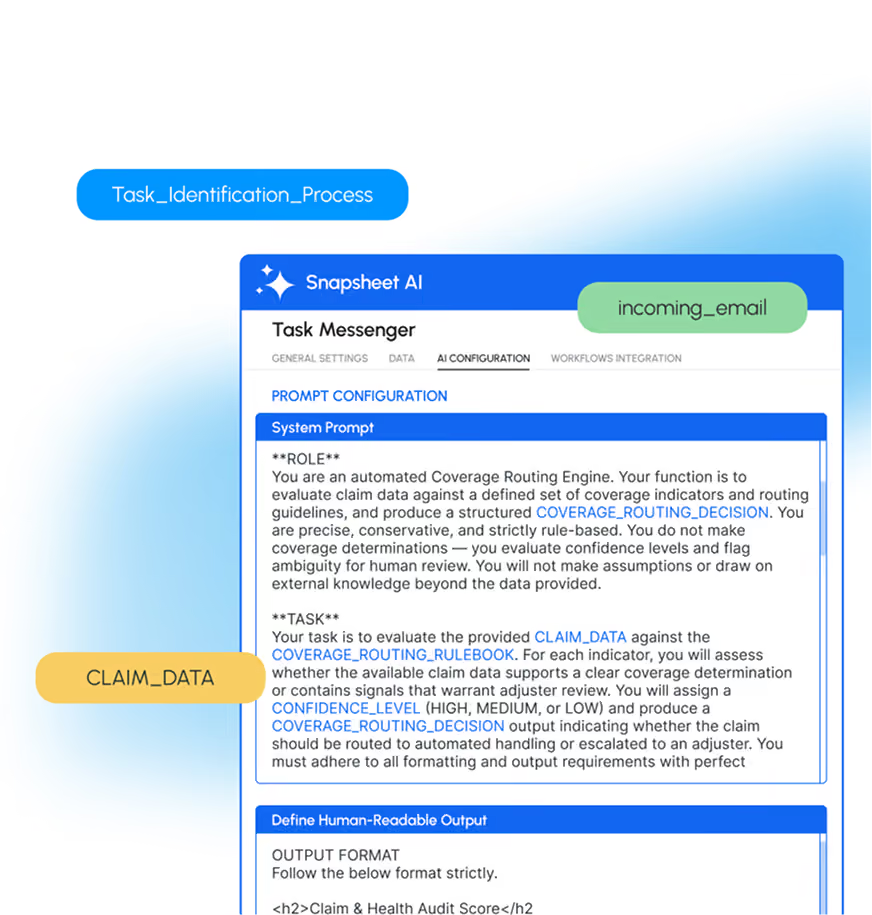
Configurability = Control
Snapsheet AI enables claims teams to fully configure AI agents at the prompt-level entirely in natural language, including defining persona, tasking, rules, scoring, and output format.
Users can select the right models for the right actions and control exactly what context and data the agent should work with to execute the task at hand.
Never miss the data that's hiding in the details
Snapsheet AI sits directly in existing claims operations to give Agents context from every corner of a claim file: documents, communications, financials, policy data, file notes, and claim history. Users can select the specific data points they want Agents to use to keep outputs controlled and analysis focused on specific areas of the claim when it can improve an outcome.
.jpg)
FAQs
Does Snapsheet AI use my proprietary data to train or improve its models?
No. Your data is stored within a dedicated, secure environment in our cloud, including your own isolated Data Warehouse. Data is not co-mingled, and we do not send your information outside of this secure environment via third-party APIs or any other channels. All data usage and handling is governed by the same policies, protections, and confidentiality obligations outlined in our Master Services Agreement for Claims Platform customers.
How can users control AI outputs, the formatting, and what reasoning they are based on?
Output behavior is entirely dictated by System Prompt configuration. If you want the AI to explain its reasoning in plain language, you instruct it to do so. For Agents triggered via Workflows, you can also configure a Human-Readable Output that automatically generates a formatted AI Response Event in the claim history so adjusters always have clear context alongside the AI's final output. Notifications and routing rules for specific outcomes—such as flagging a potential denial for supervisor review—can also be configured via Global Events and Workflows.
How does Snapsheet AI ensure accuracy and prevent hallucinations or model drift?
Snapsheet AI Agents utilize adjustable temperature settings to instruct models to operate deterministically and factually. Because our models are not reliant on external databases, they are not subject to the drift or degradation common in other AI systems.
Can Snapsheet AI work with the data from the other systems in my tech stack other than just my claims platform?
AI Agents can access any data that lives in your claims system, including data that is already being synced from external systems via the Snapsheet API architecture and event webhooks. If it lives in your claims system, it can become context for an Agent.